
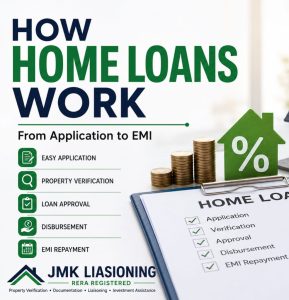
How Home Loans Work ?
Buying a home is a significant financial decision, and for many buyers, a home loan makes property ownership more manageable. A home loan allows you to purchase a property by borrowing money from a bank or financial institution and repaying the amount over an agreed period, along with interest.
What Is a Home Loan?
A home loan is a secured loan provided by a bank or housing finance company for purchasing, constructing, or sometimes renovating a residential property. The property generally serves as security for the loan until the outstanding amount is fully repaid.
How Does a Home Loan Work?
The process usually follows these key stages:
1. Assess Your Financial Eligibility
Lenders evaluate your income, employment or business profile, existing liabilities, credit history, and repayment capacity to determine how much you may be eligible to borrow.
2. Choose the Property
Once you have an approximate budget, you can identify a property that meets your requirements and financial capacity. Legal and documentation checks are important before proceeding.
3. Apply for the Loan
You submit the loan application along with documents such as identity and address proof, income documents, bank statements, and property-related documents as required by the lender.
4. Loan Assessment and Approval
The lender assesses your financial profile and the property. If the application meets its lending criteria, the lender issues a sanction letter specifying the approved loan amount, applicable interest rate, tenure, and other terms.
5. Property Verification and Documentation
The lender may conduct legal and technical due diligence on the property to verify ownership, documentation, valuation, and other relevant factors.
6. Disbursement
After completion of the required formalities, the approved loan amount is disbursed according to the lender’s terms. For under-construction properties, disbursement may happen in stages.
7. Repayment Through EMIs
The borrower repays the loan through Equated Monthly Instalments (EMIs). An EMI generally consists of both principal and interest. Over time, the outstanding principal reduces as repayments are made.
What Determines Your Home Loan Eligibility?
Your eligibility may depend on:
- Monthly or annual income
- Age and remaining working period
- Employment or business stability
- Existing loans and financial obligations
- Credit history and credit score
- Property value
- Loan tenure
- Lender’s internal eligibility criteria
A higher income does not automatically guarantee a higher loan amount. Existing financial commitments and repayment capacity also matter.
Fixed vs Floating Interest Rates
Home loans may be offered with different interest-rate structures.
Fixed Rate: The interest rate remains fixed for the applicable fixed-rate period, subject to the lender’s terms.
Floating Rate: The interest rate can change over time based on the applicable benchmark and lender’s policies, which may affect the EMI or loan tenure.
Before choosing a loan, understand the interest-rate mechanism, reset conditions, processing charges, and other applicable fees.
Understanding EMI
Your EMI depends mainly on:
- Loan amount
- Interest rate
- Loan tenure
A longer tenure can reduce the monthly EMI but may increase the total interest paid over the life of the loan. A shorter tenure generally increases the EMI but can reduce the overall interest cost.
Important Costs Beyond the EMI
Home buyers should budget for more than just the loan EMI. Depending on the transaction and lender, additional costs may include:
- Processing fees
- Stamp duty and registration charges
- Legal and technical evaluation charges
- Property insurance, where applicable
- Documentation or administrative charges
- Other applicable statutory or transaction-related costs
These expenses should be considered when calculating the total property purchase budget.
Documents Commonly Required
Requirements vary by lender and borrower profile, but commonly requested documents may include:
- PAN and identity/address proof
- Salary slips or income documents
- Bank statements
- Income-tax returns, where applicable
- Employment or business-related documents
- Property title and ownership documents
- Sale agreement or allotment documents
- Other property documents requested by the lender
Why Property Due Diligence Matters
Loan approval does not necessarily mean that a property is suitable from every legal or commercial perspective. Buyers should independently verify the property’s title, approvals, encumbrances, applicable regulations, and documentation before completing the purchase.
Professional property verification and documentation support can help buyers identify potential issues before committing significant funds. Tips Before Taking a Home Loan
- Calculate your affordable EMI rather than borrowing the maximum amount offered.
- Compare lenders on interest rates, fees, processing charges, and loan terms.
- Maintain a strong credit profile before applying.
- Keep an emergency fund instead of using all available savings for the purchase.
- Understand the loan agreement and all applicable charges.
- Verify the property documents before making major financial commitments.
- Consider the total interest cost, not just the monthly EMI.
Conclusion
A home loan can make property ownership more accessible, but it is a long-term financial commitment. The right approach is to evaluate your repayment capacity, understand the loan terms, compare available options, and conduct proper property due diligence before proceeding.
At JMK LIASIONING, we believe that a property investment should be backed by proper information, documentation, and due diligence.
होम लोन घर खरीदने के सपने को पूरा करने का एक प्रभावी वित्तीय साधन हो सकता है, लेकिन यह एक दीर्घकालिक वित्तीय जिम्मेदारी भी है। लोन लेने से पहले अपनी आय, EMI क्षमता, ब्याज दर, लोन अवधि और अतिरिक्त खर्चों को अच्छी तरह समझना जरूरी है।
साथ ही, जिस प्रॉपर्टी में निवेश किया जा रहा है, उसके टाइटल, दस्तावेज़, अप्रूवल और कानूनी स्थिति की उचित जांच करना भी उतना ही महत्वपूर्ण है।
सही जानकारी, सही दस्तावेज़ और सही निर्णय—एक सुरक्षित प्रॉपर्टी निवेश की मजबूत नींव हैं।
JMK LIASIONING – RERA Registered
Property Verification • Documentation • Liasioning • Investment Assistance
FAQs
1. What is a home loan?
A home loan is a secured loan provided by a bank or housing finance company to help individuals purchase, construct, or, in certain cases, renovate a residential property.
2. How is home loan eligibility determined?
Eligibility generally depends on income, age, employment or business profile, existing financial obligations, credit history, repayment capacity, and the value of the property.
3. What is an EMI?
EMI stands for Equated Monthly Instalment. It is the regular monthly payment made towards repaying the loan, generally consisting of both principal and interest.
4. What is the tenure of a home loan?
The loan tenure varies depending on the lender and the borrower’s eligibility. A longer tenure may reduce the monthly EMI but can increase the total interest payable.
5. What is the difference between fixed and floating interest rates?
A fixed interest rate remains fixed for the applicable period according to the loan terms, while a floating rate may change over time based on the applicable benchmark and lender’s policies.