
A Complete Guide for Property Buyers
Buying a property is a major financial decision, and property registration is one of the most important legal steps in completing the transaction. Registration provides a formal record of the transfer of ownership and helps establish the buyer’s legal interest in the property.
At JMK LIASIONING – RERA Registered, we help buyers navigate the property registration process with proper documentation, verification and Liasioning support.
What Is Property Registration?
Property registration is the legal process through which a property transaction is officially recorded with the concerned government authority.
Once the applicable documents are properly executed and registered, the transaction becomes part of the official land/property records, subject to the applicable laws and procedures.
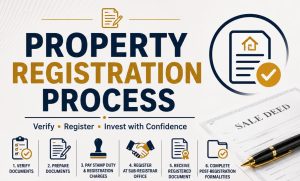
Step-by-Step Property Registration Process
1. Verify the Property Documents
Before proceeding with registration, buyers should conduct proper due diligence, including checking:
- Title and ownership documents
- Previous sale deeds and ownership chain
- Encumbrance status
- Mutation and land records
- Property tax records
- Approved building/site plans, where applicable
- RERA registration details for applicable projects
- Land-use and zoning permissions
- Identity and authority of the seller
Never rely only on the seller’s verbal assurances.
2. Finalize the Sale Terms
The buyer and seller should clearly agree on:
- Sale consideration
- Payment schedule
- Possession terms
- Existing liabilities, if any
- Fixtures and fittings included in the transaction
- Registration-related expenses
- Other terms and conditions
Depending on the transaction, an agreement to sell may also be executed before the final sale deed.
3. Calculate Stamp Duty and Registration Charges
The applicable stamp duty and registration charges depend on the state, property type, transaction value, and other applicable rules.
These charges should be calculated correctly before registration to avoid delays or additional complications.
4. Prepare the Sale Deed
The Sale Deed is one of the most important documents in a property sale.
It should accurately mention:
- Buyer and seller details
- Property description
- Consideration amount
- Payment details
- Ownership history
- Possession details
- Rights and obligations of the parties
- Applicable declarations and conditions
The document should be carefully reviewed before execution.
5. Execute and Register the Sale Deed
The parties generally appear before the concerned Sub-Registrar/registration authority along with the required documents and witnesses, as applicable.
After verification and completion of the prescribed formalities, the document is registered according to the applicable procedure.
6. Collect the Registered Document
After successful registration, the registered document is made available to the parties as per the applicable process.
Buyers should securely preserve the registered Sale Deed and related transaction records.
7. Complete Post-Registration Formalities
Registration is not necessarily the end of the process.
Depending on the property and local rules, buyers may need to complete:
- Mutation
- Updating municipal/property tax records
- Utility transfer
- Society/RWA transfer
- Possession documentation
- Other applicable government or authority records
Documents Commonly Required
The exact requirements vary by state and transaction, but commonly include:
- Sale Deed
- Identity and address proof of buyer and seller
- PAN details, where applicable
- Passport-size photographs, where required
- Previous title documents
- Property-related approvals and records
- Stamp duty/payment documents
- Encumbrance-related records, where applicable
- Power of Attorney, if applicable
- Witness identification documents
- Other documents prescribed by the registration authority
Common Mistakes Buyers Should Avoid
❌ Skipping Title Verification
A registered transaction does not replace the need for proper due diligence.
❌ Not Checking Encumbrances
Outstanding loans, claims, or other interests can create serious complications.
❌ Incorrect Property Details
Even small errors in area, boundaries, floor, plot number, or identification details should be corrected before registration.
❌ Ignoring RERA Details
For applicable real estate projects, buyers should verify the project’s RERA registration and relevant disclosures.
❌ Treating Registration as the Only Legal Check
Registration is an important step, but ownership, title, approvals, land use, and other legal aspects should also be examined.
Why Professional Liasioning Support Matters ?
Property registration involves coordination between buyers, sellers, document professionals, banks, developers and government authorities.
Professional support can help with:
Document Coordination → Verification Support → Registration Assistance → Post-Registration Follow-up
At JMK LIASIONING, our objective is to make the property transaction process more organised, transparent, and documentation-focused.
JMK LIASIONING – RERA Registered
Buy Property with Confidence.
From property documentation and verification to registration-related coordination, JMK LIASIONING provides professional real estate Liasioning support to help clients make informed property decisions.
Our Support Areas
- Property Documentation Assistance
- Title & Document Verification Support
- RERA Verification Assistance
- Registration Coordination
- Mutation & Record Assistance
- Property Due Diligence Support
- Buyer Assistance
- Real Estate Investment Advisory
Conclusion
Property registration is more than signing a Sale Deed.
A secure transaction begins with proper due diligence, accurate documentation, correct payment of applicable statutory charges, and completion of the required registration and post-registration formalities.
प्रॉपर्टी खरीदना केवल एक निवेश नहीं, बल्कि एक महत्वपूर्ण कानूनी और वित्तीय निर्णय है। इसलिए प्रॉपर्टी रजिस्ट्रेशन से पहले टाइटल, दस्तावेज़, RERA स्थिति, बकाया देनदारियों और अन्य आवश्यक अनुमतियों की उचित जांच करना बेहद जरूरी है।
सही दस्तावेज़, सही प्रक्रिया और उचित सत्यापन आपके निवेश को सुरक्षित और पारदर्शी बनाने में महत्वपूर्ण भूमिका निभाते हैं।
JMK LIASIONING – RERA Registered आपको प्रॉपर्टी डॉक्यूमेंटेशन, वेरिफिकेशन, रजिस्ट्रेशन कोऑर्डिनेशन और रियल एस्टेट लायज़निंग में प्रोफेशनल सपोर्ट प्रदान करता है
FAQs
1. What is property registration?
Property registration is the legal process of officially recording a property transaction with the concerned government registration authority.
2. Why is property registration important?
Registration creates an official record of the transaction and plays an important role in protecting the buyer’s legal interest in the property.
3. What documents should be verified before property registration?
Important documents may include title documents, previous Sale Deeds, Encumbrance status, mutation records, property tax records, approvals, and RERA registration details where applicable.
4. Is document verification necessary even for a RERA-registered project?
Yes. RERA registration is important, but it does not replace independent title verification, document checks, approval verification, and other necessary due diligence.
5. What are Stamp Duty and Registration Charges?
Stamp Duty is a statutory charge applicable to property documents, while Registration Charges are fees associated with registering the transaction. The applicable rates vary by state and transaction.
6. What is a Sale Deed?
A Sale Deed is a key legal document that records the sale and transfer of rights in a property from the seller to the buyer.
Verify First. Register Correctly. Invest with Confidence.
JMK LIASIONING-RERA Registered
Professional Real Estate Liasioning & Documentation Support
Email: liasioningjmk@gmail.com