
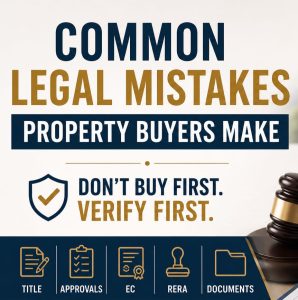
Common Legal Mistakes Buyers Make, When Purchasing Property
Buying a property is one of the biggest financial decisions you can make. While location, price, amenities and future appreciation often get the most attention, legal due diligence is equally important.
A property may look perfect on paper and still carry title issues, unpaid dues, approval problems or legal restrictions. A small mistake at the beginning can become a major financial and legal problem later.
Here are some of the most common legal mistakes property buyers should avoid.
1. Buying Without Verifying the Title
One of the biggest mistakes is assuming that the person selling the property is the legal owner.
Buyers should verify the ownership history, title documents and chain of ownership to establish whether the seller has a clear and transferable title.
2. Ignoring Encumbrances
A property could have an existing mortgage, charge, lien, dispute or other encumbrance.
An Encumbrance Certificate and relevant property records should be checked wherever applicable before proceeding with the transaction.
3. Not Checking Land Use and Zoning
A property should be legally permitted for the intended purpose.
For example, residential, commercial, agricultural and industrial properties may have different land-use regulations. Ignoring zoning restrictions can create serious problems after purchase.
4. Relying Only on the Broker or Seller
Verbal assurances are not a substitute for legal verification.
Statements such as “Everything is clear” or “The papers are complete” should always be supported by proper documentation and independent verification.
5. Not Verifying Approvals and Permissions
For applicable projects and properties, buyers should verify relevant approvals, sanctioned plans, completion or occupancy documentation, and other permissions required by the local authority.
6. Ignoring Outstanding Dues
Before buying, check whether there are pending property taxes, maintenance charges, utility dues, development charges or other liabilities connected with the property.
Unverified dues can become an unnecessary financial burden.
7. Signing an Agreement Without Understanding the Terms
Many buyers sign an Agreement to Sell or other documents without carefully reviewing clauses related to:
- Payment schedule
- Possession
- Default and cancellation
- Refunds
- Registration
- Taxes and charges
- Representations and warranties
- Dispute resolution
A document should never be signed simply because the seller says it is a standard format.
8. Making Large Payments Before Due Diligence
Paying a substantial amount before completing basic legal and documentary verification can significantly increase the buyer’s risk.
Verify first. Commit later.
9. Ignoring RERA Compliance
Where RERA applies, buyers should verify the project’s registration and examine the information available on the relevant RERA authority’s records.
RERA verification can provide important information about the project, promoter and disclosed details.
10. Not Taking Professional Legal Advice
Property transactions involve multiple documents, regulations and local requirements.
Professional assistance can help identify potential issues before the buyer commits significant money.
A Smart Buyer Does More Than Visit the Property
A site visit tells you what the property looks like.
Legal due diligence helps you understand what you are actually buying.
Before making a property investment, consider verifying:
Title → Ownership → Encumbrances → Land Use → Approvals → Dues → RERA Compliance → Agreements → Registration
Conclusion
A property purchase is not just a financial decision—it is a legal commitment.
Before investing your hard-earned money, verify the title, ownership, approvals, encumbrances, dues and other relevant documents. Don’t rely only on promises or appearances. Verify first, decide later, and invest with confidence.
प्रॉपर्टी खरीदना सिर्फ एक निवेश नहीं, बल्कि एक कानूनी जिम्मेदारी भी है।
अपनी मेहनत की कमाई लगाने से पहले प्रॉपर्टी के टाइटल, मालिकाना हक, अप्रूवल, एन्कम्ब्रेंस, बकाया राशि और जरूरी दस्तावेज़ों की सही जांच करें। केवल किसी के भरोसे या मौखिक आश्वासन पर निर्णय न लें।
पहले जांच करें, फिर निर्णय लें और आत्मविश्वास के साथ निवेश करें।
JMK LIASIONING – RERA Registered
Property Guidance • Documentation • Verification • Liasioning Support
FAQs
1. What is the biggest legal mistake property buyers make?
The biggest mistake is purchasing a property without properly verifying its title, ownership, approvals, encumbrances and relevant documents.
2. Why is title verification important?
Title verification helps establish whether the seller has a valid and transferable right to sell the property and whether there are potential ownership-related issues.
3. What is an Encumbrance Certificate (EC)?
An EC can provide information about certain registered transactions or encumbrances affecting a property for the period covered by the certificate. The exact records available depend on the relevant authority and jurisdiction.
4. Should buyers verify property approvals?
Yes. Depending on the property, buyers may need to verify sanctioned plans, land-use permissions, completion/occupancy documents and other applicable approvals.